Machine learning researcher & engineer

Mohamad Mansour

I research and build machine learning systems, with a focus on explainable AI: understanding why a model decides what it decides. I also work on reinforcement learning, NLP and computer vision, across universities, research centres, the UN and industry.

Now: I’m working at Whish Money on internal AI projects. They’re not public, so they aren’t listed below; the work here is earlier.

01 — Selected work

Research & projects

Papers, research prototypes and a few things built along the way.

  1. Present Project Whish Money

    Internal AI projects

    AI projects I’m building at Whish Money. They’re internal, so there’s nothing public to show yet.

  2. Paper American University of Beirut

    CEnt: An Entropy-based Model-agnostic Explainability Framework to Contrast Classifiers’ Decisions

    An entropy-based, model-agnostic method for interpreting machine learning models and the decisions behind them. CEnt offers actionable alternatives by generating feasible feature tweaks that change the model’s decision.

    • Deep learning
    • Explainable AI
    • Contrastive AI
    • Counterfactual prediction
    • PyTorch
    • Python
    The CEnt pipeline in five steps: train a VAE on the full dataset; sample from the VAE encoding and train a decision tree on the original representation; build a graph with the edge construction technique; locate the factual and search for the closest counterfactual node; generate counterfactuals with random perturbations.
    Fig. 1 The CEnt pipeline, from VAE to counterfactuals.
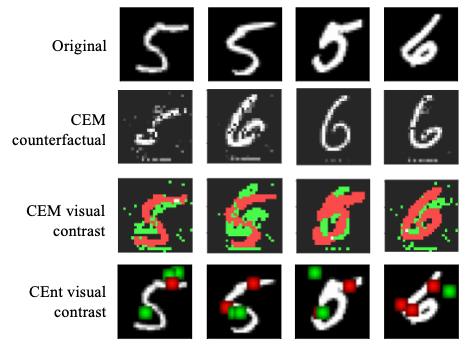
    Handwritten digits 5 and 6 shown as the original, as a CEM counterfactual, with CEM visual contrast, and with CEnt visual contrast.
    Fig. 2 Visual contrast on handwritten digits: CEnt against CEM.
  3. Paper American University of Beirut

    On the Evaluation of the Plausibility and Faithfulness of Sentiment Analysis Explanations

    Inspired by offline information retrieval, this work proposes metrics and techniques for evaluating the explanations of sentiment analysis models from two angles: how faithfully the extracted “rationales” explain the predicted outcome, and how well explainability methods agree with human judgment on a home-grown dataset.

    • Deep learning
    • Explainable AI
    • Faithfulness
    • PyTorch
    • Python
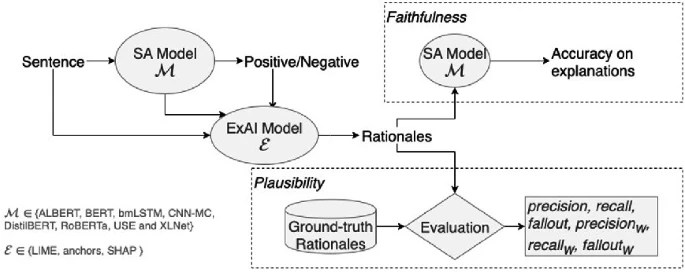
    Evaluation framework: a sentiment analysis model and an explainability model produce rationales for a sentence. Faithfulness is measured as accuracy on the explanations; plausibility is measured against ground-truth rationales using precision, recall and fallout.
    Fig. 3 Evaluating explanations for faithfulness and plausibility.
  4. Research American University of Beirut CYENS

    Navigating Agent

    Research on room navigation for embodied agents, using the FacebookResearch framework for embodied AI (Habitat). Tests combinations of reinforcement learning algorithms trained with different methodologies.

    • Reinforcement learning
    • Computer vision
    • Metacognition
    • PyTorch
    • Python
    • Multiprocessing
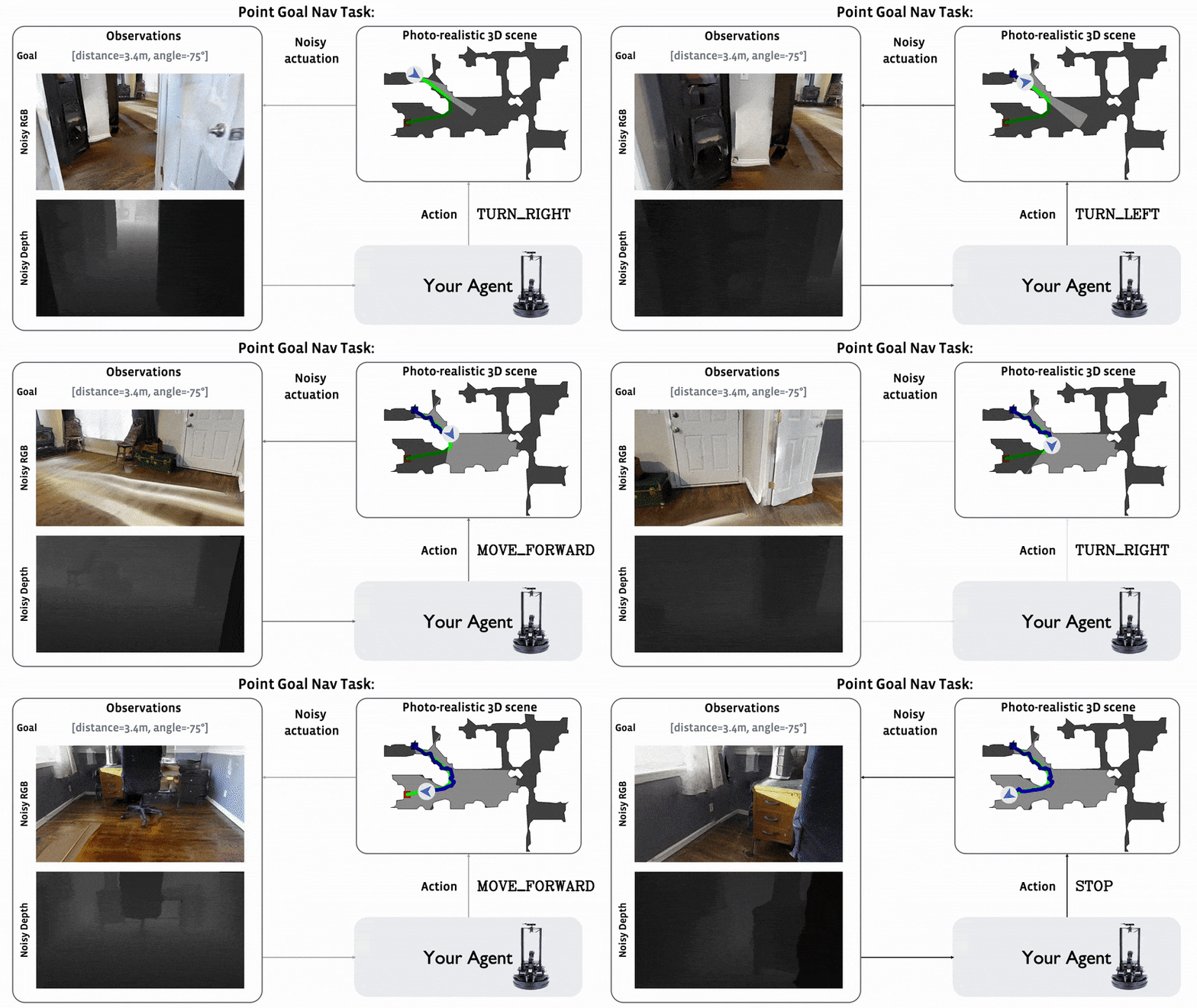
    The Habitat point-goal navigation task, as illustrated on aihabitat.org.
    Fig. 4 The Habitat point-goal navigation task, via aihabitat.org.
  5. Project

    Course Interactive Website

    With Covid-19 and cloud-based lectures, finding one specific recording meant a lot of searching. I built this interactive course website to make things easier for myself and my classmates.

    • Interactive website design
    • HTML
    • CSS
    • JavaScript
    Screenshot of the HIST 273 course website home page, with a navigation bar and a grid of lecture tiles.
    Fig. 5 The course site’s home page.
  6. Paper American University of Beirut

    Explainable Model for EEG Seizure Detection

    An explainable EEG detection model that helps diagnose epilepsy while providing deeper information, including a ranking of the features that trigger a seizure prediction.

    • Deep learning
    • Explainable AI
    • Feature extraction
    • TensorFlow
    • Python
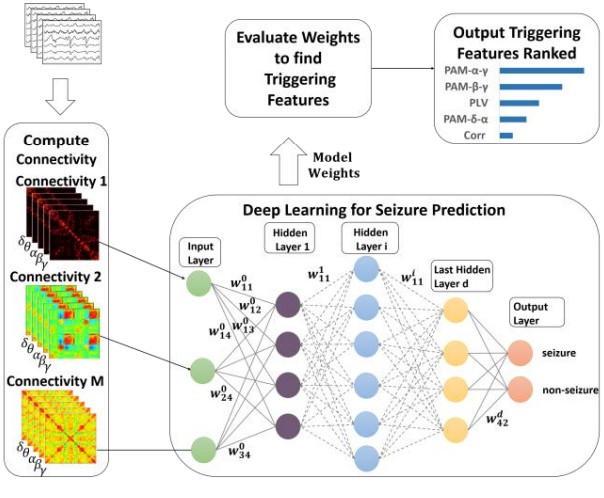
    EEG recordings are turned into connectivity features and fed to a deep network for seizure prediction. The model weights are then evaluated to rank the features that trigger a seizure prediction.
    Fig. 6 From connectivity features to ranked seizure triggers.
  7. Project American University of Beirut Asurion

    Extracting Insights

    Classifying and extracting insights from reviews, using unsupervised data augmentation.

    • Natural language processing
    • Unsupervised data augmentation
    • Python
    • Keras
    • scikit-learn
    • NLTK
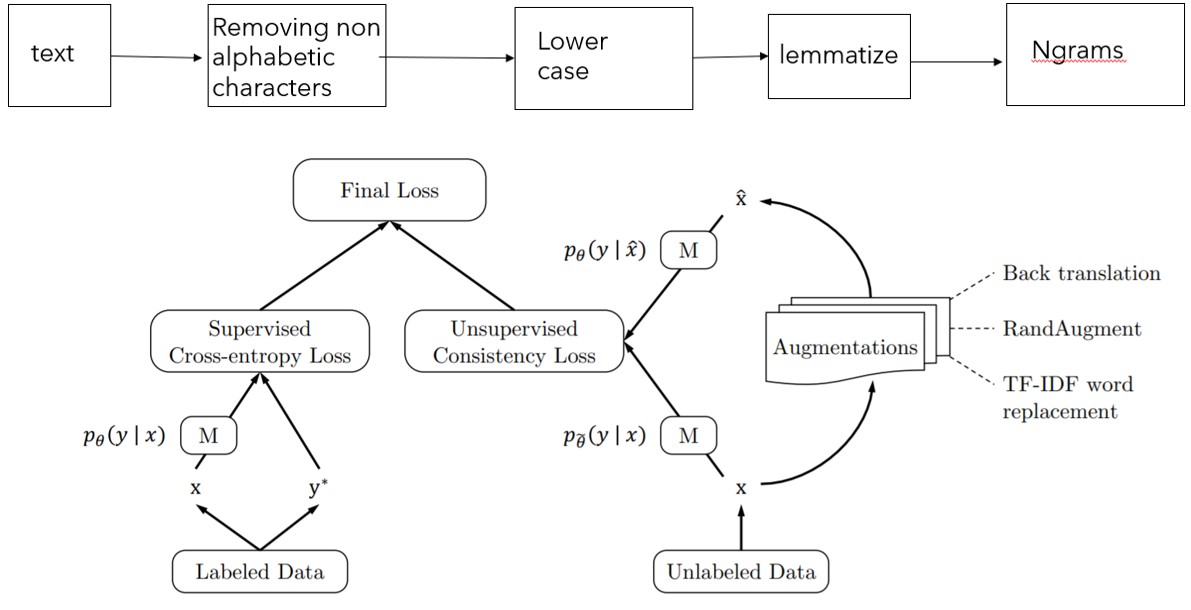
    A text preprocessing pipeline (remove non-alphabetic characters, lowercase, lemmatize, n-grams) above a diagram of unsupervised data augmentation with supervised and unsupervised consistency losses.
    Fig. 7 Review preprocessing and unsupervised data augmentation.

03 — Contact

Let’s talk.

For research collaborations, engineering work, or questions about anything above, email is best.

moemansour03@gmail.com